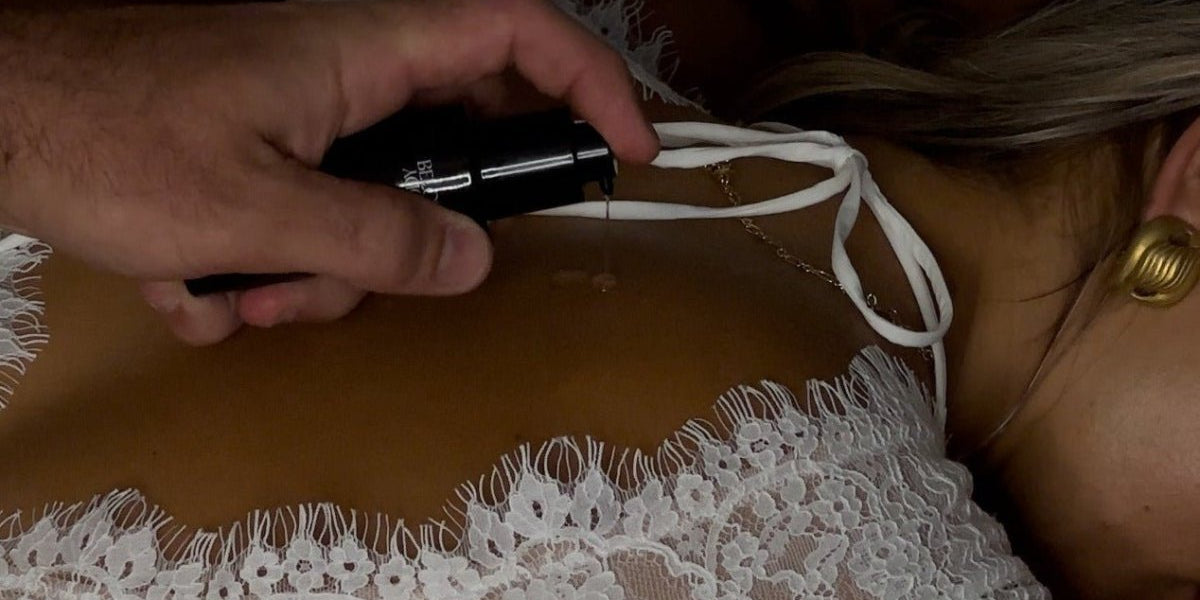
The first time most people light a massage candle, they wait about two minutes, dip a finger in, and find almost nothing there. That is normal. A massage candle is not designed to melt quickly. It is designed to melt gently, at a low enough temperature that the pool of oil can go straight onto skin without any drama.
This post explains how a massage candle actually works: what it is made of, why the temperature behaves differently from an ordinary scented candle, how to test it safely, and how to get more than fifty uses out of one jar rather than ten. There is a comparison table, a step by step, and the honest limitations too.
If you take one thing away, take this: the wax is the product. Everything else is packaging.
What a massage candle is made of
An ordinary scented candle is usually paraffin, a petroleum derived wax, or a paraffin and soy blend. Paraffin has a relatively high melting point, commonly in the region of 46 to 68 degrees Celsius depending on the grade. That is fine for something you never touch. It is not fine for skin.
A massage candle is built the other way around. It starts from waxes and butters that are soft and low melting by nature: soy wax, shea butter, and plant oils such as jojoba, coconut, almond and hemp. Soy wax typically melts somewhere in the range of 46 to 54 degrees Celsius, and shea butter softens far lower, closer to 32 to 38 degrees. Blend those together and you get a wax that liquefies at a temperature much closer to your own body than to a hot bath.
Our own candle, Melt at A$69 for 175g, is built on exactly that logic: shea butter, jojoba oil, coconut oil, hemp oil, almond oil and soybean oil, scented with sugar plum, lemongrass, cedarwood, amber and tonka bean. It is hand poured in Australia, vegan, and dermatologically tested for all skin types.
Why the melting point matters more than the ingredient list
Plenty of candles advertise natural ingredients. Fewer are formulated so the finished pool sits at a temperature that is comfortable on skin. A well made massage candle should feel warm and slightly indulgent, similar to a towel out of the dryer, not hot. If a candle stings, tightens or makes you flinch, it was not made for this and no amount of good marketing changes that.
Is a massage candle safe on skin?
A properly formulated massage candle is safe on intact skin, and the reason is temperature and ingredients rather than magic. The oil pool is low temperature by design, the wax is cosmetic grade, and the fragrance load is kept low enough for skin contact.
The sensible precautions are short and worth following.
-
Patch test first. Put a small amount on the inside of your forearm and leave it for twenty four hours before using it more widely, especially if you have reactive skin or a known fragrance sensitivity.
-
Never pour onto broken skin, sunburn, freshly waxed skin, or anywhere irritated.
-
Do not use a massage candle internally and do not treat it as a lubricant. It is a skin product.
-
Do not use an ordinary scented candle this way. Paraffin candles run hotter and can carry dyes and fragrance loads that were never intended for skin.
- If you are pregnant, have a skin condition, or are unsure about a specific ingredient, ask a pharmacist or your GP. That is a two minute conversation, not a fuss.
How to test the temperature before you pour
Do this every single time, even once you know the candle well.
- Blow the flame out. Never pour from a lit candle.
- Tip a few drops onto the inside of your own wrist, not your partner's.
- Count to five. If it still feels comfortable, it is ready.
- Pour a small amount first onto a large, less sensitive area such as the upper back or shoulders, then work outward.
Skin on the inner thighs, chest and neck is thinner and reads heat faster than the back. Start where the skin is thickest.
Massage candle, scented candle, or bottled oil
These three things get grouped together and they behave very differently.
| |
Massage candle |
Ordinary scented candle |
Bottled massage oil |
| Main ingredients |
Soy wax, shea and plant butters, cosmetic oils |
Often paraffin or paraffin blends, higher fragrance load |
Carrier oils such as grape seed, jojoba, sweet almond |
| Safe on skin |
Yes, when formulated for it |
No |
Yes |
| Temperature |
Warm, close to body temperature |
Hot, not intended for contact |
Room temperature unless warmed |
| Ready to use in |
Ten to fifteen minutes |
Not applicable |
Immediately |
| Sets the mood |
Yes, light and scent included |
Yes |
No |
| Best for |
A slow, unhurried massage at home |
Scenting a room |
Quick or frequent use, larger areas |
If you want an honest recommendation: bottled oil is more practical for a fifteen minute shoulder rub on a Tuesday. A candle is better when the point is the ritual rather than the efficiency. Many people end up with both, which is why we sell The Massage Ritual at A$129, pairing Melt with our oil.
How to use a massage candle, step by step
-
Trim the wick to about five millimetres before every burn. An untrimmed wick produces a taller flame, more soot and an uneven pool.
-
Light it and leave it alone for ten to fifteen minutes. Use that time to warm the room and lay out towels.
-
Check the pool. On the first burn especially, wait until the melted layer reaches the edges of the jar. This is called a full melt pool and it prevents the candle from tunnelling down the middle and wasting wax.
-
Extinguish the flame. A snuffer or the jar lid is cleaner than blowing, which scatters soot into the oil.
-
Test on your own wrist, count to five, then pour a small amount into your palm rather than straight onto your partner.
-
Warm it between your hands for a few seconds, then apply with long, slow strokes. Add more as you go instead of pouring a large amount at once.
-
Let the candle cool fully before you put the lid on, then store it out of direct sunlight and away from heat.
If you have never given a proper massage before, technique matters more than product. Our guide to how intimacy supports your wellbeing covers why unhurried touch is worth the time, and the room itself does a surprising amount of the work, which we cover in our piece on creating a calm, sensual space at home.
How long should you burn it for
Keep any single session to two hours or less, and never leave a burning candle unattended or near fabric, curtains or anything that moves in a breeze. Two hours is plenty. Most massages are done inside forty minutes.
How many uses you should expect
A 175g massage candle used sensibly gives well over fifty uses. At A$69 that is under a dollar per use, which is a more useful number than the sticker price. Candles that tunnel because they were never given a full melt pool can lose a third of their wax to the sides of the jar, so that first careful burn genuinely pays for itself.
Storing it properly
Heat is the enemy. In an Australian summer a candle left on a windowsill or in a car can soften, slump and lose its scent. Store it below about 25 degrees Celsius, lid on, out of direct sun. Keep it away from the bathroom shelf directly above a heater. If the surface looks slightly uneven or frosted after a hot week, that is cosmetic and does not affect how it performs.
If you are giving one as a gift, our Gifts and Bundles collection is put together with this in mind, and everything ships in discreet packaging with nothing on the outside naming the brand or the contents.
Frequently asked questions
Can you put massage candle wax directly on your skin?
Yes, if the candle is specifically made as a massage candle, because it uses low melting waxes and butters such as soy and shea rather than paraffin, so the melted oil sits close to body temperature. Blow the flame out first, test a few drops on your own wrist, and never pour wax from an ordinary scented candle onto skin.
How hot does a massage candle get?
A massage candle is formulated so the melted pool feels warm rather than hot, closer to a warm towel than a hot bath, because its soy and shea base liquefies at a much lower temperature than paraffin. The safest approach is not to rely on numbers but to test the oil on your inner wrist and count to five before applying it anywhere else.
How long do you have to wait for a massage candle to melt?
Allow ten to fifteen minutes from lighting to a usable pool of oil. Smaller jars may be ready slightly sooner and a candle in a cold room will take longer. On the first burn, wait until the melted layer reaches the edge of the jar, which stops the candle tunnelling and wastes far less wax over its life.
What is the difference between a massage candle and a regular candle?
A massage candle is made from cosmetic grade, low melting ingredients meant for skin contact, while a regular scented candle is usually paraffin based with a higher fragrance load and is only meant to scent a room. The two are not interchangeable, and pouring a regular candle onto skin risks a burn.
How many times can you use one massage candle?
A 175g massage candle typically gives more than fifty uses, which works out at well under a dollar per session. You will get closer to that number if you trim the wick to five millimetres before each burn and allow a full melt pool on the first use so the wax does not tunnel and cling to the sides of the jar.
Where to start
If you are buying one thing, buy the candle and use it slowly. Melt is A$69 for 175g and will outlast most people's expectations. If you would rather have the oil as well for shorter sessions, The Massage Ritual is A$129. And if you are buying for someone else and would rather they choose, a Below Body gift card starts at A$50.
Free shipping applies to orders over A$100 across Australia and New Zealand. Take your time with it. There is nothing here to fix.