


Secret Santa and Kris Kringle Gifts for Her, Under A$100
The office gift exchange has unwritten rules nobody says out loud. What to buy at a A$30, A$50 or A$100 cap, what reads as thoughtful rather than cheap, and what is never right for a...

Most home massages go wrong in the same two ways. The person giving it presses too hard, and the person receiving it spends the whole time slightly cold. Neither problem is about skill. Both are easy to fix before you touch anyone.
This is a practical guide to how to give a massage at home: setting the room up, the strokes worth knowing, how much pressure to actually use, and an ordered sequence for the back, shoulders and neck with rough timings. No training required.
One thing at the start, because it matters. A massage at home is for comfort and connection, not treatment. Pain that keeps coming back belongs with a GP or a physiotherapist.
Do all of this before anyone lies down. Getting up halfway through to find a towel undoes the entire mood.
A body lying still loses heat quickly. Aim for 22 to 24 degrees Celsius, which will feel slightly warm to you while you are moving around. In an Australian winter that means turning the heating higher than feels normal, and in summer it means not pointing the air conditioning at the bed. Cover whatever you are not working on.
A soft bed absorbs most of what you push, so pressure goes nowhere. Better options, in order: a firm mattress, a doona folded twice on the floor, or a yoga mat with a towel over it. If your own back hurts after ten minutes, the height is wrong.
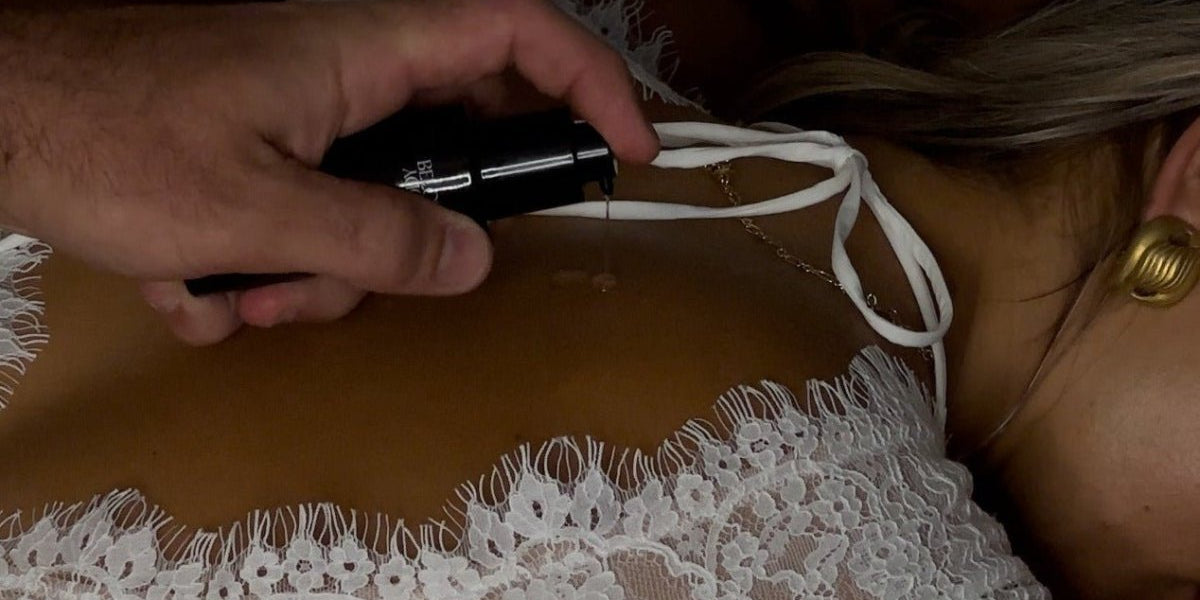
If you are using a candle, light it before anything else. Melt, A$69 for 175g, needs ten to fifteen minutes to pool, roughly the time the towels and the music take. It burns low enough that the oil sits warm rather than hot, and that matters: cold oil on a warm back makes people tense for the first two minutes.
Sit or kneel beside the person's hip, facing along the length of their body rather than across it. This lets you push with your body weight rather than your arms, which is the biggest reason home massages exhaust the giver. Keep at least one hand resting on the body when you reach for more oil.
None of these need training. All of them need slowing down.
Long, gliding strokes with the flat of the hand, following the length of the muscle. This is how you start, how you finish, and how you move between areas. Pressure is light to moderate. Its job is to spread the oil, warm the tissue and let the person get used to being touched. Spend longer here than feels necessary.
Kneading. You lift, squeeze and roll the muscle between your fingers and the heel of your hand, like working dough but slower. Best on fleshy areas: the tops of the shoulders, the sides of the back and the thighs. This stroke does most of the real work on a tight shoulder.
Small, focused circles with the thumbs or fingertips, working into one spot rather than travelling. Use it on knots, on the muscle bands either side of the spine, and around the shoulder blade. Keep each spot to about thirty seconds, then glide away with effleurage. Always warm the area first.
Light rhythmic tapping with the sides of loosely cupped hands. It is stimulating rather than relaxing, so most home massages are better without it.
Here is the rule that fixes most of it: if you want more effect, go slower rather than harder.
Use a scale of one to ten, where one is a feather and ten is unbearable. Almost all of a good massage happens between four and seven. Seven should feel like a firm ache the person can still breathe through easily. If they hold their breath or tighten up, you are past useful and into enduring. Ask once at the start, once ten minutes in, and otherwise watch their breathing.
Pressing harder is the most common substitute for technique, and it is the wrong one. Deep work is slow work.
If you have twenty minutes rather than forty, keep steps one, two, three and eight and cut the rest. Do not keep the sequence and halve every stroke.
Persistent back or neck pain, numbness, tingling or pain that wakes someone at night is not a massage problem. That is a conversation with a GP or a physiotherapist.
A candle gives you warm oil and light in one object, which suits a slower evening. A bottled oil is more practical if you do this often or work over a large area. If you want both, The Massage Ritual pairs Melt with our oil for A$129.
Worth being clear about one thing, because a lot of brands are not: Nurture, A$89 for 50ml, is formulated for the pubic area and the skin around it, not as a general body oil for a full back massage. Two to three drops warmed between the palms is the intended amount.
If the massage is part of a larger evening, our date night tool kit is a good companion piece, and the way you set up the room matters more than most people realise, which we cover in our guide to creating a calm, sensual space at home.
Warm the room to around 22 to 24 degrees Celsius, use a firm surface rather than a soft bed, warm your oil, and spend the first five minutes on long gliding strokes before doing anything deeper. Work with your body weight instead of your arms, keep pressure at about a four to seven out of ten, and go slower rather than harder.
Aim for four to seven on a scale where ten is unbearable, which should feel like a firm ache the person can still breathe through comfortably. If they hold their breath or tense up, ease off immediately. When you want a deeper effect, slow the stroke down rather than pressing harder, because speed, not force, is what makes pressure uncomfortable.
Forty minutes is a good length for a full back, shoulders and neck massage, and twenty minutes is enough for shoulders alone. Anything under ten minutes rarely gives the muscles time to warm up and relax. If you are short on time, do fewer areas properly rather than rushing through the whole sequence.
Avoid pressing directly on the spine itself and work the muscle bands either side of it instead. Also keep away from the kidneys area low on the sides, any bruise, rash, swelling or recent injury, and anywhere that produces sharp or radiating pain rather than a dull ache. The front and sides of the neck need very light pressure only.
A light plant based oil such as grape seed, jojoba or sweet almond works well, because it glides without soaking in too quickly or leaving a heavy residue. A massage candle made with soy and shea gives you the same effect with the oil already warmed. Avoid essential oils applied undiluted, and patch test anything new twenty four hours beforehand.
You need three things: a firm surface, a warm room and something to glide with. If you buy one item, make it the candle. Melt is A$69, gives over fifty uses and handles the lighting too. For a gift, our Gifts and Bundles collection is the simplest place to look, and a Below Body gift card from A$50 leaves the choice with them.
Shipping is free on orders over A$100 across Australia and New Zealand. Then put your phone in another room and take your time.

